
A drawing the user changes
setEditable(true) lets the user move, resize, rename, bend and delete. Every
one of those goes to the server before it counts, and the page has the last word
on it:
panel.setEditable(true).setModel(m_model)
    .setChangeHandler(change -> {
        if(change.getType() == GraphOpType.Remove && change.getCell() == m_hub) {
            return false;                        // The hub stays
        }
        return true;
    });
What a change is
IGraphChangeHandler has one method, acceptChange(GraphChange), and it is
asked before the model is touched. Returning false refuses: the model keeps
what it had, and what it has is sent back to the browser, which puts the drawing
back to it. Without a handler every change is accepted.
change.getType() |
What the user did | What the change carries |
|---|---|---|
Geometry |
moved or resized a node | getGeometry() |
Label |
renamed a cell (double click) | getLabel() |
Terminal |
dragged an edge end onto another node | getSource(), getTarget() |
Points |
bent an edge | getPoints() |
Remove |
deleted a cell (Delete) | nothing but the cell |
There is a Style change as well, carrying getStyle(), but the user has no way
of making one: styling a cell is the page's to do.
getCell() is the cell it is about, and the cell is still as it was: the change
has not been made yet. What the shape stands for is on the cell too - see the
user object in the model - which is usually what a rule is
really about.
Deleting a node deletes the edges that hang on it, because that is what the browser does with them. Those edges are one gesture with the node: they follow its verdict, and the handler is not asked about them separately.
Adding is a request, not a change
The browser never makes a cell. It cannot: ids are the model's, and a cell invented in the browser would be one the server has no name for. So the browser says what the user did - dropped a palette item here, drew a connection from this node to that one - and the page answers with the cell it wants:
panel.addPaletteItem(task)
    .addPaletteItem(decision)
    .setCreateHandler(new IGraphCreateHandler() {
        @Override
        public GraphNode createNode(GraphModel model, GraphPaletteItem item, double x, double y) {
            GraphNode node = item.create(model, x, y);
            node.setUserObject(item.getKey());
            return node;
        }

        @Override
        public GraphEdge createEdge(GraphModel model, GraphNode source, GraphNode target) {
            if("done".equals(source.getUserObject())) {
                return null;                     // Nothing leads out of a Done
            }
            return model.addEdge(source, target);
        }
    });
What the handler makes arrives in the browser as an ordinary change, with the id the model gave it - one round trip, and no name that has to be corrected afterwards.
Returning null is how a drawing says what may not be drawn in it. There is nothing to take back, because nothing was made.
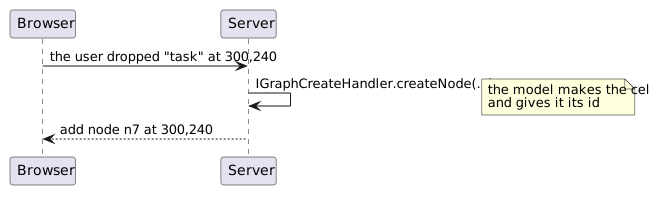
A GraphPaletteItem is what the user drags: a key, a label, a size and a style.
Only its look goes to the browser, and item.create(model, x, y) is the
one-liner a handler usually answers with.
Connections can only be drawn where the panel has a create handler. The dot that starts one sits in the middle of a node - exactly where dragging the node would otherwise move it - so a drawing that cannot gain edges does not lose that.
Undo is the model's
m_model.setUndoEnabled(true);                    // Off until it is asked for

bb.addButton("Undo", () -> m_model.undo());
bb.addButton("Redo", () -> m_model.redo());
The browser keeps no history of its own, and could not: the node the user deleted still exists here, with its id and the page's own data on it, while over there nothing is left to put back. So ctrl-Z and ctrl-Y in the drawing only say that the key was pressed, and what comes back is an ordinary list of changes.
| Method | What it does |
|---|---|
setUndoEnabled(boolean) |
keep a history. Off by default, so building the drawing does not fill the stack |
undo() / redo() |
one step back or forward; false when there is nothing left |
canUndo() / canRedo() |
whether a button should be enabled |
edit(Runnable) |
everything done inside it is one step |
setUndoLimit(int) |
how many steps are kept; 50 by default |
clearHistory() |
start again - what loading another drawing calls |
One gesture is one step, and a gesture is often several changes: deleting a
node deletes its edges with it, and undoing that brings the node and its edges
back together. Everything one round trip does is one step, model.edit() groups
what the page does itself, and a change the handler refused never enters the
history at all - nothing was done, so there is nothing to take back.