
Asynchronous and long-running work
Three components for the same problem in two shapes: work that takes longer than a request should, and a screen that has to change without the user doing anything.
- The components
- All three rest on the same poll
- The rule the two async components share
- Carrying context into the worker
The components
| Component | For |
|---|---|
AsyncContainer |
a long job, on a thread of its own, with a progress report and a cancel button |
AsyncDiv |
the same job, where the component - not the job - builds the result |
PollingDiv |
a piece of the screen that refreshes itself while the user watches |
All three rest on the same poll
A DomUI page only changes when a request arrives. So a screen that has to change by itself needs a request to arrive by itself, and that is what the framework's poll is: while there is anything on the page that needs it, the browser asks the server every couple of seconds - two and a half by default - whether anything changed, and whatever changed comes back as an ordinary delta.
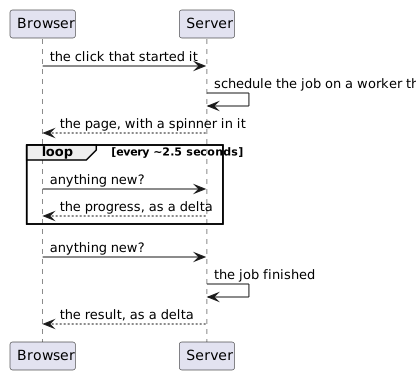
Polling can be switched off with the domui.polling developer option. With it
off, an AsyncContainer throws when it is created rather than hanging, which
is the message to read when a long job stops working on a development machine.
The rule the two async components share
The job runs on a different thread, and while it runs the page it was started from is not active at all. So it may not touch that page:
- not its components, and not its fields;
- not the page's shared
QDataContext- a job that needs the database makes one of its own withQContextManager.createUnmanagedContext(), and closes it; - what it produces goes into the job object itself, on synchronised fields, and is read out when it is done - in a request where the page is alive again.
The Progress it is handed is the exception: reporting into it is how the
spinner gets its percentage, and asking it is how the job learns it was
cancelled.
public void run(Progress p) throws Exception {
    p.setTotalWork(rows.size());
    for(int i = 0; i < rows.size(); i++) {
        if(p.isCancelled())                 // Cancelling only works if the job checks
            return;
        process(rows.get(i));
        p.setCompleted(i, "row " + i);      // The text appears next to the percentage
    }
}
Carrying context into the worker
A worker thread has none of the request's context - no logged-in user, no
locale, no transaction. An application that needs some of it registers an
IAsyncListener on its DomApplication:
addAsyncListener(new IAsyncListener<MyContext>() {
    @Override public MyContext onActivityScheduled(IAsyncRunnable r) { return capture(); }
    @Override public void onActivityStart(IAsyncRunnable r, MyContext c) { install(c); }
    @Override public void onActivityEnd(IAsyncRunnable r, MyContext c) { clear(); }
});
onActivityScheduled runs on the request thread and collects whatever is needed;
onActivityStart and onActivityEnd run on the worker thread, around the job,
and put it in place and take it away again.