
Typed properties
Every query on the previous page named its properties with a string:
q.ilike("artist.name", "%" + part + "%");
q.ascending("title");
That works, and it is what QCriteria has always accepted. But a string is invisible to the compiler, and this page is about getting it back in view.
- What a string costs you
- The same query, typed
- What Album_ actually is
- Paths of any depth, and child collections
- A property is a value
- Turning it on
- Where to go from here
What a string costs you
Four things can be wrong with q.ilike("artist.name", part), and the compiler
notices none of them:
- A typo.
"artst.name"compiles perfectly. - A rename. Rename
Artist.getName()togetFullName()and your IDE rewrites every caller - except the ones inside strings. The query keeps compiling and stops working. - The wrong type.
q.eq("title", 12)compiles: the method takes anObject. - The wrong entity. On a
QCriteria<Album>,q.ilike("composer", part)compiles too, even thoughAlbumhas no such property.
All four turn into a runtime failure, at the moment the query is executed - which
may well be the moment a user opens the screen. And it goes the other way too:
you cannot ask your IDE who uses Artist.name, because nothing references it.
The same query, typed
QCriteria<Album> q = QCriteria.create(Album.class);

String title = titlePart.getValueSafe();
if(title != null) {
	q.ilike(Album_.title(), "%" + title + "%");
}
String artist = artistPart.getValueSafe();
if(artist != null) {
	//-- artist() walks to the parent, name() is its property: both are checked.
	q.ilike(Album_.artist().name(), "%" + artist + "%");
}
q.ascending(Album_.title());
q.limit(20);
Fill in an artist and look at the query box: it says artist.name, exactly as
before. A typed property is that path - it produces the same query, and every
QCriteria method that takes a String property has a twin that takes a typed
one instead.
What changed is what happens when you get it wrong. All four mistakes above are now compile errors:
q.eq(Album_.title(), 12);              // no suitable method found for eq(QField<Album,String>,int)
q.ilike(Album_.artst().name(), "%x%"); // cannot find symbol: method artst()
And the rename is no longer special: Album_ is generated from Album, so
renaming the getter renames the method, and every call site that used it fails
to compile until you fix it. Asking the IDE for the usages of Album_.title()
now answers the question that "title" could not.
What Album_ actually is
Album_ is a generated class, sitting next to Album in the same package. It
has one static method per property, and each returns a QField<R, P>: R is
the class the path starts at, P is the type of the property at the end of it.
QField<Album, String> title = Album_.title();
title.getName();                   // "title"

QField<Album, String> artistName = Album_.artist().name();
artistName.getName();              // "artist.name"
A property pointing at another generated class gets a second generated class, so that the path can continue:
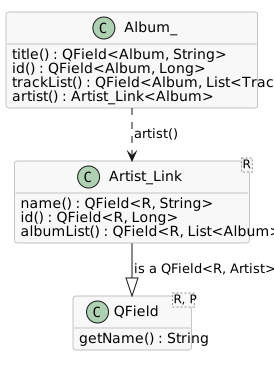
Artist_Link<Album> is itself a QField<Album, Artist>, so it can be handed to
a query as a property in its own right and it carries the Artist properties
as methods. That is the whole trick behind chaining: Album_.artist() is both a
property and the next step of a path.
Paths of any depth, and child collections
//-- Track -> album -> artist -> name, every step checked by the compiler.
q.ilike(Track_.album().artist().name(), "%" + part + "%");
q.ascending(Track_.album().title()).ascending(Track_.name());
ExistsRestrictor<Album> albums = q.exists(Album.class, Artist_.albumList());
albums.ilike(Album_.title(), "%" + part + "%");
The path can be as long as the model allows, and the query box shows what it
became: album.artist.name. A typo anywhere along it is a missing method rather
than a query that returns nothing.
exists() still wants the child class next to the property, because the type of
a List<Album> cannot be recovered from the property alone. The property itself
is checked, though: Artist_.albumList() only exists while Artist has that
collection.
Not every method has a typed twin yet, and the ones that do keep the string
form as well. Where you find only a String overload, that is what to use -
mixing the two in one query is fine.
A property is a value
Take the following code:
/**
 * Render a list of anything, labelled by whatever String property of it you pass in.
 */
private <T> Div listOf(List<T> list, QField<T, String> labelProperty) throws Exception {
	PropertyMetaModel<String> pmm = MetaManager.getPropertyMeta(labelProperty.getRootClass(), labelProperty);

	Div box = new Div("dm-tut");
	for(T item : list) {
		Div line = new Div();
		box.add(line);
		line.add(pmm.getValue(item));
	}
	return box;
}
With that we can easily generalize code in a compile- and typesafe way:
QCriteria<Artist> aq = QCriteria.create(Artist.class);
aq.ascending(Artist_.name()).limit(5);
cp.add(listOf(getSharedContext().query(aq), Artist_.name()));
...
cp.add(listOf(getSharedContext().query(tq), Track_.album().artist().name()));
listOf works for artists, for albums and for tracks, and it never casts
anything. The QField<T, String> carries both halves of what the method needs:
getRootClass() says which class the property belongs to, and the String in
the type says what reading it gives back - so pmm.getValue(item) is a String
to the compiler as much as to the reader.
This is what typed properties buy you beyond queries. A property becomes an
ordinary value: you can pass it to a method, keep it in a constant, put a list of
them in a field. Written as strings, the same helper would need a Class<T>
alongside the name and a cast on the way out, and neither would be checked.
Turning it on
The classes are generated during compilation, by an annotation processor. It generates for every class annotated with either of:
@jakarta.persistence.Entity- so all your JPA entities are covered without doing anything.@to.etc.annotations.GenerateProperties- for any other class. Typed properties are not a database feature; a plain model class can get them just as well.
Add the processor to the maven-compiler-plugin configuration of every module
that has such classes - or once, in the pluginManagement of the parent pom:
<plugin>
    <groupId>org.apache.maven.plugins</groupId>
    <artifactId>maven-compiler-plugin</artifactId>
    <configuration>
        <annotationProcessors>
            <annotationProcessor>db.annotationprocessing.PropertyAnnotationProcessor</annotationProcessor>
        </annotationProcessors>
        <annotationProcessorPaths>
            <dependency>
                <groupId>to.etc.domui</groupId>
                <artifactId>property-annotations-processor</artifactId>
                <version>${domui.version}</version>
            </dependency>
        </annotationProcessorPaths>
    </configuration>
</plugin>
@GenerateProperties itself lives in a small artifact of its own, which the
module needs as an ordinary dependency:
<dependency>
    <groupId>to.etc</groupId>
    <artifactId>annotations</artifactId>
    <version>${domui.version}</version>
</dependency>
The generated sources land where annotation processors always put them -
target/generated-sources/annotations, in the package of the class they came
from - and are compiled along with everything else. There is nothing to check in
and nothing to keep up to date by hand.
DomUI compiles with the Eclipse batch compiler through
plexus-compiler-eclipse, and annotation processing needs at least version
2.8.4 of it. Older versions ignore the processor silently: no error, no
generated classes.
IntelliJ picks all of this up from the poms. If it complains that the processor
cannot be found - which happens when DomUI is a source submodule, because then
nothing formally depends on the processor - add the same
property-annotations-processor artifact as a plain dependency of the modules
that need it, and check
Settings → Build, Execution, Deployment → Compiler → Annotation Processors.
What gets generated, and what does not
Generating a property for everything would be slow and useless, so the processor generates one when the property's type is:
- a simple type: a primitive or its wrapper,
String,BigDecimal,BigInteger,java.util.Date,java.sql.Date, or any enum; - a class that is itself annotated with
@Entityor@GenerateProperties- this is what produces the_Linkclass that lets paths continue; - a collection of such a class;
- or anything at all whose getter carries a
@Columnannotation, since that says it is persisted whatever its type is.
To leave one out, put @IgnoreGeneration on the getter. Not on the field: a
property is defined by its getter, and the processor never looks at fields.
Where to go from here
What the processor writes for a class, and the full set of rules that decides whether a property gets a method - including the ones that quietly leave a property out - are in Typed properties: the annotation processor.