
Page objects
The same two tests as on the previous page, written against a page object:
public class ITOrderEntryPageObject extends AbstractWebDriverTest {
	@Test
	public void orderingSaysWhatWasOrdered() throws Exception {
		POOrderEntryTestPage page = new POOrderEntryTestPage(wd());
		page.open();

		page.customer().setValue("Ozymandias");
		page.shipping().setValue("Express");
		page.copies().setValue("2");
		page.order("Revolver");

		Assert.assertEquals("Ozymandias ordered 2 x Revolver, Express, total 34.95", page.answer().getText());
	}

	@Test
	public void theBasketShowsWhatIsForSale() throws Exception {
		POOrderEntryTestPage page = new POOrderEntryTestPage(wd());
		page.open();

		Assert.assertEquals(3, page.basket().getVisibleRowCount());
		Assert.assertEquals("Rubber Soul", page.basket().row(0).album().getText());
		Assert.assertEquals("14.95", page.basket().row(0).priceEach().getText());
	}
}
Not one testid, not one css selector, no input inside a div: the test says
what it does. Everything about how the screen is built sits in
POOrderEntryTestPage, and when the screen changes, that is the only place
that changes with it.
What a page object is here
A page object is a class that represents one screen. It knows the page class, so it can open it, and it hands out one proxy per component on it.
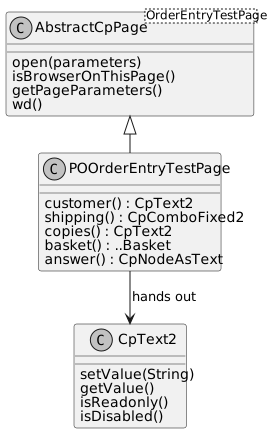
Each proxy holds a supplier of a css selector, not an element: it is asked
for the element again on every call, so a proxy survives the page being rebuilt
by an AJAX round trip - which an ordinary Selenium WebElement does not.
customer = new CpText2(this.wd(), () -> "*[testId='customer']");
The proxies that exist
They live in to.etc.domui.webdriver.poproxies. Every input proxy implements
ICpControl<T>, which is setValue, getValue, isReadonly and
isDisabled, and every proxy inherits isPresent(), isDisplayed(),
getText() and the waitTillPresent() calls from AbstractCpComponent.
| Proxy | For |
|---|---|
CpText2, CpText, CpTextArea, CpHtmlInput |
text input |
CpCheckbox, CpCheckboxButton, CpRadioGroup<T> |
choice input |
CpComboFixed2, CpComboLookup2, CpComboFixed, CpComboLookup |
dropdowns; the value is the option's label |
CpLookupInput2, CpLookupInput, CpNumberLookupControl |
lookup controls |
CpButton, CpLinkButton |
things that are clicked |
CpDisplaySpan, CpNodeAsText |
things that only show text |
CpDataTable<R>, CpDataTableColumn, CpDataTableRowBase |
a table, its columns and its rows |
CpWindow, CpMsgBox |
a floating window and a message box |
CpTabPanel, CpAceEditor |
the tab panel and the code editor |
AbstractCpPage<T> is the base of the page object itself: open(parameters)
opens the page it is typed on, isBrowserOnThisPage() and
waitUntilPageUrlContains() answer questions about where the browser ended up,
and getPageParameters() returns the parameters in the current URL.
Writing one by hand
A page object is an ordinary class; nothing forces you to generate it:
public class POLoginPage extends AbstractCpPage<LoginPage> {
	private CpText2 m_userName;

	public POLoginPage(WebDriverConnector connector) {
		super(connector, LoginPage.class);
	}

	public CpText2 userName() {
		CpText2 userName = m_userName;
		if(null == userName) {
			userName = new CpText2(wd(), () -> WebDriverConnector.getTestIDSelector("username"));
			m_userName = userName;
		}
		return userName;
	}
}
A proxy per component, made once and kept in a field, behind a method named after the component. That is a lot of very regular typing, which is why the generator exists: it writes exactly this, by looking at the page while it is on the screen.
Tables
A table needs three classes, and this is the shape the generator produces as
well: the table (a CpDataTable) hands out columns and rows, and a row
hands out the components in its cells.
page.basket().getVisibleRowCount();          // rows on this page of the table
page.basket().row(0).album().getText();      // a cell of a row
page.basket().row(1).order().click();        // the link button in a cell
Row and column numbers are zero-based, and row(n) is the nth row currently
rendered, not the nth row of the model: a table that pages shows the rows of
the current page only.
Steps of your own
A page object is also the place for the vocabulary of your tests. The order entry object has one:
	/**
	 * Order the album with this title, whichever row of the basket it is in.
	 */
	public void order(String album) throws Exception {
		for(int i = 0; i < basket().getVisibleRowCount(); i++) {
			if(album.equals(basket().row(i).album().getText())) {
				basket().row(i).order().click();
				return;
			}
		}
		throw new IllegalStateException("The basket does not contain " + album);
	}
The test then says page.order("Revolver") and no longer cares which row
Revolver is in - the difference between a test that survives a new album in the
basket and one that does not.