
The generic query layer (QCriteria)
Using databases shows what a query
looks like: QCriteria.create(Album.class), restrictions, or(), dotted paths, exists()
and limit(), run on the context a page hands you. This page is about the layer itself -
what the query object is, what happens between dc.query(q) and the SQL, and the parts
of it a tutorial has no room for: selections, subqueries, raw SQL conditions, and running
a query with no database at all.
- The query is a tree, and nothing else
- From query to SQL
- What the translator does with a dotted path
- exists: how the subselect is built
- Selections: more than one thing per row
- Subqueries in a restriction
- When the query layer will not do
- A query without a database
- If you know Hibernate's Criteria API
- What is not implemented
The query is a tree, and nothing else
Everything you call on a query adds a node to an expression tree held in the query object. There are only four classes involved:
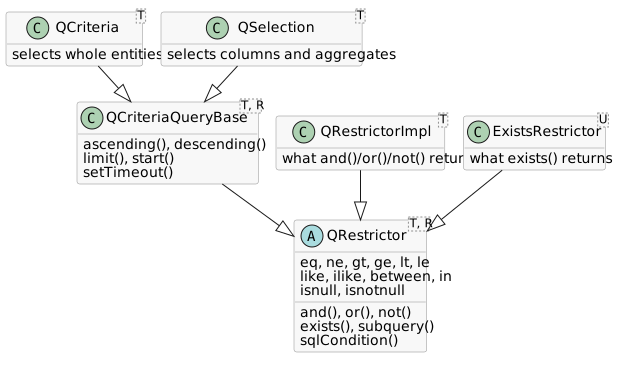
QRestrictor is a place to add conditions to; QCriteriaQueryBase adds what a whole
query has on top of that - ordering, a limit, a timeout. QCriteria and QSelection
differ only in what a row of the result is. Everything else in the picture is a restrictor
you get handed back by and(), or(), not() or exists(), and it behaves exactly like
the query does.
The conditions themselves are QOperatorNodes - QPropertyComparison for
property op value, QMultiNode for an and/or with its children, QUnaryNode for
not and the null tests, QExistsSubquery for a child condition. Nothing interprets them
at the time you write them. They are walked later, by a QNodeVisitor, and which
visitor is doing the walking decides what the query becomes:
| Visitor | Produces |
|---|---|
QQueryRenderer |
the readable form you get from toString() |
CriteriaCreatingVisitor (hibutil) |
a JPA CriteriaQuery, to be run by Hibernate |
CriteriaMatchingVisitor (domui) |
a yes/no answer for one object already in memory |
That is what "database independent" means here in practice: a QCriteria holds no
connection, no session and no dialect, so building one needs no database, and the same
object can be printed, executed, executed again on another context, or matched against a
list.
From query to SQL
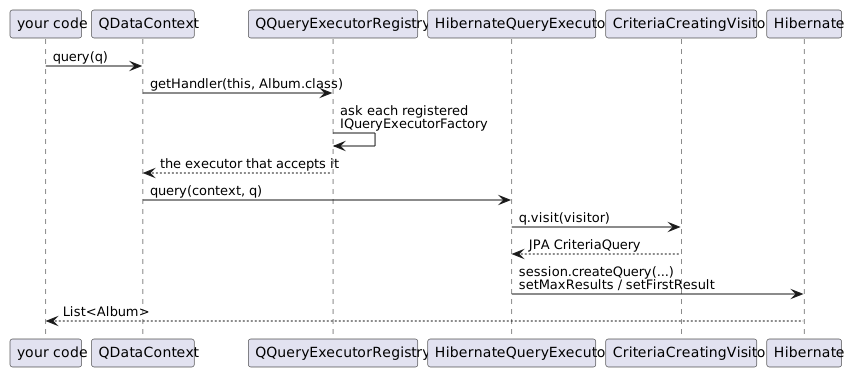
The registry is a list of IQueryExecutorFactory, and it is asked per queried class:
each factory is offered the class and returns an executor or null, first non-null wins.
Setting up Hibernate registers two of them, in this order:
JdbcQueryExecutor(to.etc.webapp.qsql), which accepts a class carrying@QJdbcTable- a small JDBC-only implementation for classes that are not entities of the ORM at all.HibernateQueryExecutor, which accepts everything else.
So a single QDataContext can serve both kinds of class, and which machinery runs a query
is decided at query time, from the class being selected. Registering a factory of your own
in front of those is all it takes to route some classes somewhere else entirely.
limit() and start() are not part of the criteria tree at all: they become
setMaxResults() and setFirstResult() on the finished query, and setTimeout(seconds)
becomes the query timeout.
IQueryListener is called with every query just before it is executed and may change
it - HibernateConfigurator.registerQueryListener() installs one. It is the place to
add a condition that must be on every query in an application, rather than putting it
in every screen.
What the translator does with a dotted path
Each segment of invoice.customer.firstName that navigates through an association
becomes an explicit join, and the join type is chosen from the relation:
- an optional association is joined with a
LEFTjoin, - a required one with an
INNERjoin, which returns the same rows and is cheaper.
The reason for going out of the way to do that is a trap in JPA: a path built with
Path.get() renders as an inner join, and an inner join silently drops the rows that have
no relation - so
QRestrictorImpl<Server> or = q.or();
or.isnull("environment");
or.eq("environment.lifecycle", Lifecycle.ACTIVE);
would never return a server without an environment, although the first arm of the or asks
for exactly those.
Two more things happen there, and both matter when reading generated SQL:
- Joins are cached per relation. A query restricting on
invoice.billingCityandtrack.namejoinsInvoiceonce andTrackonce, however many conditions use them, and anorover two different parents works as written. - A path that ends in the association's id needs no join:
artist.idis answered from the foreign key column that is already in the row.
exists: how the subselect is built
exists(Album.class, "albumList") becomes a correlated subselect, and everything it needs
is taken from the mapping:
- the child class comes from the collection's element type,
- the join condition comes from the collection's
mappedByproperty: the subquery root'sartistcompared with the outer root.
That second point is a requirement: a one-to-many with no mappedBy - a unidirectional
collection - cannot be used, and the query fails with a QQuerySyntaxException saying so
rather than producing something wrong.
A path that crosses more than one collection is rewritten into nested exists
subqueries before translation, so these two are the same query:
//-- One exists across two collections...
q.exists(Track.class, Artist_.albumList() + "." + Album_.trackList())
	.ilike(Track_.name(), "%word%");

//-- ...is rewritten into this.
q.exists(Album.class, Artist_.albumList())
	.exists(Track.class, Album_.trackList())
	.ilike(Track_.name(), "%word%");
The rendered form shows the path that was reached:
FROM to.etc.domui.derbydata.db.Artist WHERE exists (select 1 from $[parent.albumList.trackList] where name ilike '%word%')
The path may also walk up before it goes down - exists(Invoice.class, "customer.invoiceList")
from an Order - in which case the part before the collection becomes the parent side of
the join condition.
Why a child condition is a subselect rather than a join, and what it does for limit(), is
in Using databases.
Selections: more than one thing per row
QSelection<T> is the other query. It sits on the same base as QCriteria, so every
restriction, ordering and limit works identically; what differs is that you say which
columns you want, and a row comes back as an Object[]:
QSelection<Invoice> q = QSelection.create(Invoice.class);
q.sum(Invoice_.total());
q.selectProperty(Invoice_.customer());

List<Object[]> rows = dc.query(q);           // {BigDecimal, Customer} per row
The selectors are selectProperty, id, count, countDistinct, distinct, min,
max, avg and sum, each with an optional alias, and each in a String and a typed
form.
Grouping is implicit. Every plain property selected - selectProperty and id -
is added to the group by; the aggregates are not. The query above therefore groups by
customer and sums the invoice totals per customer, and there is no groupBy() call to
forget.
Reading the rows as something better than Object[]
An interface whose methods say where they sit in the row turns the array into something
readable, and QDataContext will do the mapping:
private interface CustomerTotal {
	@QFld(0)
	double sum();

	@QFld(1)
	Customer customer();
}

List<CustomerTotal> list = dc.query(CustomerTotal.class, q);
Each method must carry @QFld(index); the value at that index is converted to the method's
return type. There is a queryOne(Class, QSelection) for the single-row case. The
implementation is a java.lang.reflect.Proxy over the Object[], so nothing is copied and
no class is generated.
QQueryUtils.queryCount(dc, criteria) goes the other way: it takes a QCriteria you
already built, moves its restrictions into a QSelection that counts id, and gives you
the number - the usual way to ask "how many would this find" without fetching them.
Subqueries in a restriction
Two forms, for two different questions.
in with a selection - a plain, uncorrelated subquery:
QSelection<Customer> subq = QSelection.create(Customer.class);
subq.selectProperty(Customer_.country());
subq.eq(Customer_.city(), "Paris");

QCriteria<Customer> q = QCriteria.create(Customer.class);
q.in(Customer_.country(), subq);             // country in (select country from ... )
subquery() - a correlated one, which can refer back to the outer query. This finds
the invoice lines that carry the highest unit price of their invoice:
QCriteria<InvoiceLine> rootq = QCriteria.create(InvoiceLine.class);

QSubQuery<InvoiceLine, InvoiceLine> subq = rootq.subquery(InvoiceLine.class);
subq.max("unitPrice");
subq.join("invoice");                        // same invoice as the outer row
subq.join(rootq).ne("id", "id");             // ...but not the outer row itself

rootq.eq("unitPrice", subq);
join(property) correlates the subquery with the outer query over a relation, and
join(otherQuery) gives a restrictor whose comparisons take a property on each side rather
than a property and a value - ne("id", "id") is their ids differing, not an id
differing from a string.
When the query layer will not do
sqlCondition() puts a fragment of raw SQL in the where clause, with its parameters kept
out of the string:
q.sqlCondition("this_.Total > (select avg(Total) from Invoice)");
this_ in the fragment refers to the root of the query and is rewritten to whatever alias
the generated statement actually uses, which is not predictable in advance. Everything else
in the fragment is yours, database dialect included - it is the escape hatch, not a
feature to reach for.
A query without a database
Because a QCriteria is just a tree, it can be evaluated against objects you already have:
List<Album> matching = MetaManager.query(albumList, q);
CriteriaMatchingVisitor walks the same restrictions against one object at a time using
DomUI's metadata to read its properties, and the result is sorted by the query's own
ordering. Restrictions and ordering are all it does: limit(), start() and anything
needing the database (exists, subqueries, sqlCondition) are not applied. It is the way
to filter a list that a screen is holding with the criteria that screen already builds.
For unit tests there is a second no-database route. Give a query a testId and
TestDataContextMock will return the result registered under that id instead of executing
anything, which lets code that queries be tested without a schema:
QCriteria<Album> q = QCriteria.create(Album.class).testId("albums-by-title");
A query reaching the mock without a testId fails loudly rather than silently returning
nothing.
If you know Hibernate's Criteria API
The shape is familiar but the semantics are not the same, and the differences are deliberate:
- A
QCriteriais always what Hibernate calls detached: it holds no session, so it is built, kept, passed around and executed wherever - and there is one class for it, not two unrelated ones. - It is typed on the entity:
QCriteria<Album>gives aList<Album>and the property methods have typed forms through typed properties. - It is not tied to an ORM. The Hibernate translation is one executor among the registered ones, chosen per class.
- A condition on a child collection is an
existssubselect, never a join - so an entity appears once however many children match, andlimit()counts entities rather than joined rows. In Hibernate the same query returns the parent once per matching child, and a limit on it quietly limits the wrong thing.
What is not implemented
fetch()andQFetchStrategydo nothing. The path is checked against the class, and an unknown one is an error, but the strategy is then ignored: the current translator has no eager-fetch support, and a query that asks for one is executed without it.QMultiSelection- a selection over more than one operand - is rejected by the Hibernate translator.- The translator builds a JPA
CriteriaQuerybut runs it on a HibernateSession; there is no executor that works against a plain JPAEntityManagerin the built code.