
Themes
A theme is a directory of SCSS with a style.scss in it. DomUI ships one,
winter. An application has exactly one theme, and it is chosen once, during
initialization, by handing DomApplication the factory that builds it:
setThemeFactory(SassThemeFactory.INSTANCE);
That is all most applications ever do with themes. It cannot be changed afterwards, and there is no way to have two themes in play at the same time.
What can differ from session to session is the theme's variant - which is how a dark and a light version of the same theme are done.
Variants
A variant is a name, and nothing more. DomUI ships one of its own - dark, a dark
version of the winter theme - as DarkThemeVariant.INSTANCE; declare your own the
same way:
static public final IThemeVariant HIGH_CONTRAST = IThemeVariant.of("high-contrast");
Set it on the request context and it holds for the rest of the session - and for the sessions after it, because the choice goes into a cookie as well:
UIContext.getRequestContext().setThemeVariant(DarkThemeVariant.INSTANCE);
The stylesheet link is written by the full page renderer, so after switching the
page has to be reloaded for the new sheet to arrive. The demo does that with
appendJavascript("WebUI.refreshPage();"), which keeps the conversation and so
keeps whatever the user had typed:
The sun/moon button at the top right of every demo page is the whole of it - see
ThemeVariantSwitch in the demo source. Press it, close the browser, come back:
the page is still the way you left it.
The first visit
A user who has not chosen anything yet gets the scheme their desktop is set to. The preference lives in the browser and the theme is a server side stylesheet, so DomUI asks for it in the one place where the two meet - a script at the top of the page head, before the stylesheet the browser is about to fetch:
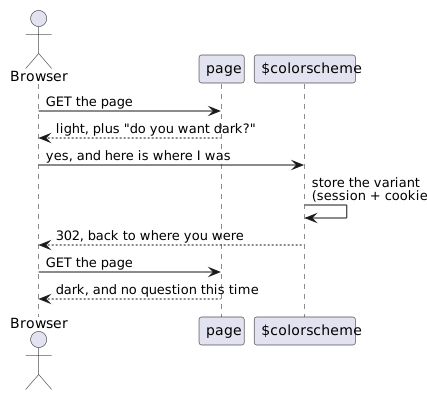
Because the script leaves before the stylesheet is fetched, nothing has been painted yet: the user sees the page they wanted, not a flash of the other one.
The question is only put to a browser that has nothing stored, so it is asked once
and then never again - and pressing the switch answers it too. What each answer
means is getThemeVariantForColorScheme() in your DomApplication; returning
null from it stops the question being asked at all, which is what a theme with no
dark variant of its own must do:
@Override
public IThemeVariant getThemeVariantForColorScheme(String colorScheme) {
	return null;
}
To decide the variant per user instead - from a preference stored with the account,
say - override calculateUserThemeVariant() in your DomApplication. It is asked
when neither the session nor the cookie holds a choice, so switch the browser
question off as well or it will overrule what you return:
@Override
public IThemeVariant calculateUserThemeVariant(IRequestContext ctx) {
	return userPrefersDark(ctx) ? DarkThemeVariant.INSTANCE : super.calculateUserThemeVariant(ctx);
}
Sessions that get through all of that without a variant render in default.
Where a theme file comes from
The style and the variant become a search path, tried in order until a file is found:
| Order | Path | Present when |
|---|---|---|
| 1 | $themes/scss/<style>/<variant> |
the variant is not default |
| 2 | $themes/scss/<style> |
always |
| 3 | $themes/scss/all |
always |
Because the first directory that has a file wins, a variant overrides exactly what it wants to and inherits the rest. That is how the shipped dark variant is built - one file, and no rule of the theme repeated anywhere:
themes/scss/winter/dark/_color.scss
The theme loads its variables through color; under the dark variant that
name finds dark/_color.scss, under default it finds the theme's own. The
same works for an image - a dark/btnCancel.png is served only to sessions
rendering in dark, and every image the variant does not replace still comes
from winter.
That one file is enough because _color.scss is where the theme's two variable
modules are loaded, and a module's !default variables can be given their
values by whoever loads them. The variant's file loads them with its own
values:
@forward "variables" with (
	$white:        hsl(220, 13%, 11%) !default,		// page background
	$grey-darker:  hsl(220, 14%, 88%) !default,		// $text-strong, input text
	...
);
@use "variables" as v;
@forward "derived-variables" with (
	$pmnu-bg: v.$white-ter !default,
	...
);
and _derived-variables.scss recomputes text, background, border, link and
input colours from what _variables.scss was given. The !default on each
value is what lets an application's _custominit.scss still win over the
variant. The dark one mostly turns the greyscale ramp upside down - $white
becomes the darkest surface, $grey-darker the lightest text - so every rule
that reaches for "the light end of the ramp" gets a dark colour without knowing
it.
For that to work a rule has to have a variable to take its colour from. The theme names the ones a variant is most likely to want:
| Variable | Used for |
|---|---|
$body-bg, $body-color |
the page itself |
$grey-ramp, ladder() |
anything that nests - see below |
$line-color |
every line that is not part of a control: the edge of a panel, window, pane or menu, and rules between table cells |
$surface-bg, $surface-color |
panels, popups, menus, layout panes |
$surface-alt-bg |
a band or a second step up from a surface |
$input-bg, $input-color, $input-ro-bg-top/-bottom |
input controls |
$border, $border-hover |
the border of a control - these come from the greyscale ramp, so they follow a variant already |
$row-hover-bg, $row-hover-outline |
the hover wash on a table row |
$cal-* |
the jscalendar popup (_calendarTheme.scss) |
Where a colour is named
Colours live in two tiers, and a component reads only the second.
The main set is in _variables.scss. Its names say what a colour is in the theme's
own vocabulary and never mention a component - $primary, $line-color, $surface-bg,
$input-bg, the $errors-* / $warnings-* / $info-* states, the $black..$white
greyscale ramp.
Component colours are in _derived-variables.scss: one variable per colour a
component paints, each defaulting to a main-set value.
//-- LogTailer (.ui-tlf-*)
$tlf-hdr-bg: $primary !default;
The component's own stylesheet then reads only its own variables - never a literal, and never a main-set value directly:
.ui-tlf-hdr {
	background-color: $tlf-hdr-bg;
}
That indirection is the point. An application can restyle one component by setting one variable, a variant can move the whole theme by setting the main set, and neither has to edit a component.
Both tiers name variables the same way, in kebab-case:
$<component>-<part>-<role>
<component> |
the component's CSS class prefix with ui- removed - tlf for .ui-tlf-*, pmnu for .ui-pmnu-*. The main set omits it. |
<part> |
the element inside it, where a component paints more than one thing: hdr, title, item. Omitted where it paints one. |
<role> |
what the colour does, and the part that must not vary: -bg, -color (text - the word CSS itself uses, never a background), -border, -outline, -shadow. |
Underscores and hyphens are the same character to SCSS: $link-color and $link-color
are one variable. An application that sets a theme variable by its old snake_case
spelling therefore still sets the current one, and the rename that brought the theme's
last 79 such names into line changed not one byte of the compiled stylesheet.
Things that nest
A component whose levels nest - a submenu inside a submenu, a tree inside a tree -
should not hand-pick a grey per level. $grey-ramp is the theme's greyscale as an
ordered list, and ladder() walks it:
$pmnu-bg: $grey-darker !default;			// the component's own rung

.ui-pmnu     { background-color: ladder($pmnu-bg);    }
.ui-pmnu-sm1 { background-color: ladder($pmnu-bg, 1); }		// one level in
.ui-pmnu-sm2 { background-color: ladder($pmnu-bg, 2); }		// two levels in
A negative level walks the other way, for something that sits under the component's own surface - a title band, a border. Walking off either end of the ramp clamps rather than failing.
Two things this buys. The steps stay even and stay distinct: the popup menu used to
pick #666 and #888 for its middle two levels, close enough that rounding each to
its nearest ramp step would have collapsed them into one colour. And a variant only
sets the base - $ladder-direction inverts with the ramp, so a ladder keeps stepping
away from the page ground in either variant. The dark variant's whole entry for the
popup menu is two lines:
$ladder-direction: -1 !default,		// the ramp is inverted, so ladders walk it the other way
$pmnu-bg: v.$white-ter !default,	// a raised dark surface instead of an inverted one
A partial that still writes a colour literally cannot be redressed by a variant -
so when you find one, give it a variable here rather than overriding it in the
variant. An application stylesheet, which the theme has no variables for, can
branch on the variant's name instead: that is what the demo does in
css/_darkstyle.scss for its own colours, reading p.$themeVariant from the
parameters module.
The $ on the front of $themes makes DomUI's resource resolver handle the
name, and it looks in four places, in this order:
- a file in the webapp directory -
<webapp>/themes/scss/winter/style.scss - in development mode,
META-INF/resources/themes/...on the classpath, reloaded when it changes - a resource served by the servlet container
- the classpath, under
/resources/- which is where DomUI's own theme lives
An application file therefore wins over the framework's, and that is the hook the whole of overriding the theme hangs on.
How the stylesheet reaches the browser
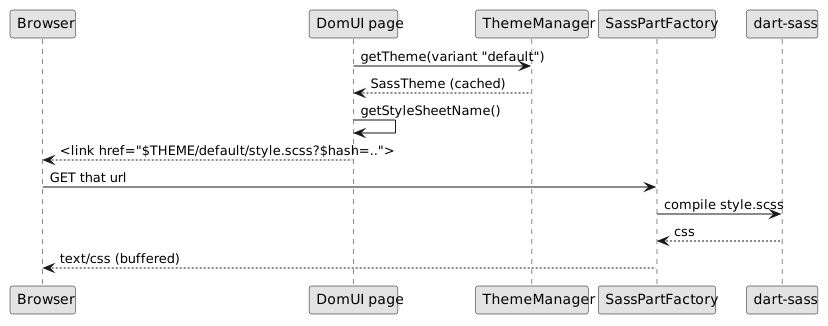
Every themed URL carries the variant as its first segment - $THEME/default/...,
$THEME/dark/... - so the variant decides which file is served, and two variants
never share a cache entry.
Nothing is compiled ahead of time and nothing is written to disk. The page emits
a $THEME/-prefixed link whose query string carries a hash of the compiled
result, so the URL changes whenever the stylesheet does and the browser cache
never has to be reasoned about.
ThemeManager keeps the built ITheme objects in a map keyed by variant name.
It tracks the resources each was built from, so a changed file invalidates the
entry rather than being served stale.